I.2.9a
2/10/2021
HAH, FUCK INTUITION. I SPENT A GOOD AMOUNT OF SECTION 1 TRYING TO PICTURE ALL THOSE
AFFINE SURFACES AND CONCEPTS, BUT I DON'T HAVE A FUCKING CLUE WHAT'S GOING
ON PICTORIALLY IN THE PROJECTIVE CASE. I'M JUST MANIPULATING EQUATIONS.
I'M. JUST. FUCKING. AROUND. WITH. SYMBOLS. I DON'T KNOW WHAT'S GOING ON.
FUUUUUUUUUUUUUUUUUUUUUUUUUCK.
WTF is this? Why am I taking an affine set, moving it to Pn, and taking its closure? IDK. To quote a wise
soul:
And with that, let's get started.
We have worked with the homeomorphism ϕ0 before, and in particular here are the details of the β they refer to:
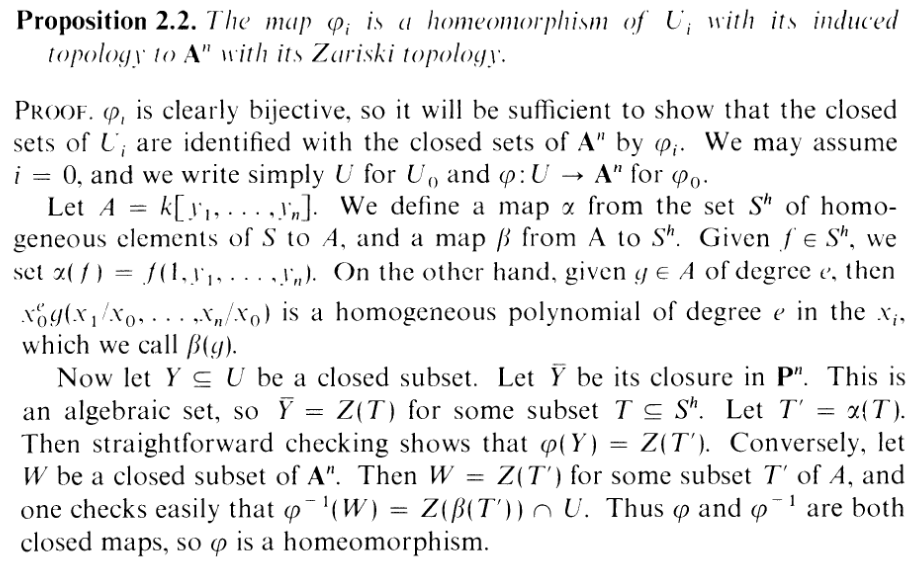
(Btw: You know how where it says "straightforward checking" and "one checks easily...". I never actually checked
these. Muahahahahaha).
I'll be using this proof quite a bit. Like the proof, I may sometimes use U and ϕ sinstead of U0 and ϕ (though note
the Y in this exercise is sorta different from the Y in theirs. CAREFUL).
NOTE: In this exercise, we care not about the set β(I(Y )) ⊂ Sh itself but the ideal generated by
β(I(Y )) in S, which is denoted Sβ(I(Y )) ⊂ S. So our goal is to show that I(Y ) = Sβ(I(Y ))
Also, like earlier, the "bar" notation for closure is kinda confusing. Here's the definition of this exercise's Y in the trusty cl
notation:
 | (1) |
Alright, ready for some messy business? Okay. Since Y is an affine variety, I can write Y = Z(T′) for some
T′⊂ A. And the 2.2 proof tells us that ϕ-1(Y ) = Z(β(T′)) ∩ U0. Taking the closure clPn of both sides, we
get
 | (2) |
Well, that's an ugly right hand side. Let's actually try to figure out that that closure is. I would LIKE to get rid of
the U. Can I? I got stuck here for a while, and then I decided to invoke this good old property just to see what
happens:
"If A is a subspace of X containing S, then the closure of S computed in A is equal to the intersection of A and
the closure of S computed in X: clAS = A ∩ clXS"
Let me write C = Z(β(T′)) for simplicity.
Remember that C is irreducible, so by 1.6,
 | (3) |
Now, using that property,
| clC(C ∩ U) | = clPn(C ∩ U) ∩ C | |||||
 clC(C ∩ U) ∩ C | = C | using (3) | ||||
 clPn(C ∩ U) | ⊃ C |
Hence clPn(C ∩ Y ) = C. I.e. (2) turns into
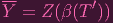 | (4) |
(Man that closure property has saved my butt more than once).
Now, we care not about this mysterious β(T′), but β(I(Y )). That's okay, because remember that T′ and Y are
related by Y = Z(T′). And we can assume without loss of generality that our T′ is not just a subset of A, but a
prime ideal in A, hence, I(Y ) = T′. We're trying to figure out what I(Y ) is, so let's take I of both
sides:
 | (5) |
As you can see, we're getting closer to what we need (NOTE: I'll write T′ = I(Y ) for simplicity, so my goal is to show I(Y ) = Sβ(T′)). Remember, we care about the ideal Sβ(T′), not the set β(T′). Fortunately, By definition of Z in Pn, we have Z(Sβ(T′)) = Z(β(T′)) (I'm PRETTY sure. *Note to self: may wanna double check this lol) so we can rewrite (4) as:
 | (6) |
Great! Now just apply the Nullstellensatz and we get
| I(Y ) | =
 |
(also I like how I'm calling it a "square root" even though it's not meant to be that lol... "radical" is the right word).
So I tried showing Sβ(T′) to be radical (or to be prime) and... it didn't quite work out for me. I don't know if there's a good way to do that directly, but I settled on showing the reverse inclusion instead. I.e. I want to show that Sβ(T′) ⊃ I(Y ):
Look above at the proof of 2.2 again. To show the inclusion we have so far I used the part about W ("Conversely, let W be..."). SO, perhaps for the reverse inclusion, I can use the part about α and Y , where their "Y " is analogous to our ϕ-1(Y ). What does it tell us? Well, firstly, clPnϕ-1(Y ) = Z(T) for some T ⊂ Sh (i.e. Y = Z(T)). And if you let T′′ = α(T). Then it turns out that ϕ(ϕ-1(Y )) = Z(T′′). I.e. Y = Z(T′′). Also, remember that Y = Z(T′), so Z(T′) = Z(T′′)... but T′ and T′′ are not necessarily equal (one is prime ideal and the other is just a set). Actually, T′′⊂ T′ ( T ′′ ⊂ I(Z(T′′)) = I(Y ) = T′ ).
Motherfuck.
MOTHERFUCK.
I told you this was going to be messy.
Now, reader, I'm going to have you take for granted that
 | (7) |
I'll justify it later (EDIT: didn't get around to typing this up lol. It's in my notes). Since T′′ = α(T), we're actually saying that β(T′′) ⊃ T. Now taking the ideal generated by both sides, we get
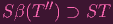 | (8) |
Why does this help us? Well, remember Y = Z(T). So taking I of both sides here. yields I(Y ) =
 .
NNNNOOOOOOOOOOOOOOOOOO, IT'S ANOTHER SQUARE ROOT (I mean "radical") IN OUR WAY.
WAIT. We can get around this.
 is a homogenous ideal, i.e. generated by homogenous elements. So we can
assume without loss of generality that T ⊂ Sh is precisely such a set of generators (since there were no
requirements on T) AND HENCE
 = ST. I.e. I(Y ) = ST. Now using equation (8), we have
Sβ(T′′) ⊃ I(Y ). OOPS. We have an extra apostrophe. I was trying to show S(β(T′)) ⊃ I(Y ). How do I get rid
of that apostrophe! NNNNNNNOOOOOOOOOOOOOO IT'S AN APOSTROPHE IN OUR WAY.
Actually, no worries, I already showed that T′′⊂ T′. So β(T′′) ⊂ β(T′) and Sβ(T′′) ⊂ Sβ(T′).
Hence
| Sβ(T′) | ⊃ Sβ(T′′) | ||
| ⊃ I(Y ) |
AND. WE. ARE. FUCKING. DONE.
Holy FUCK. Was that supposed to be THAT FUCKING COMPLICATED? I'm guessing I did this in an extremely inefficient way.
That was bad, but I'm even more worried about part (b).