I.2.2
2/2/2021
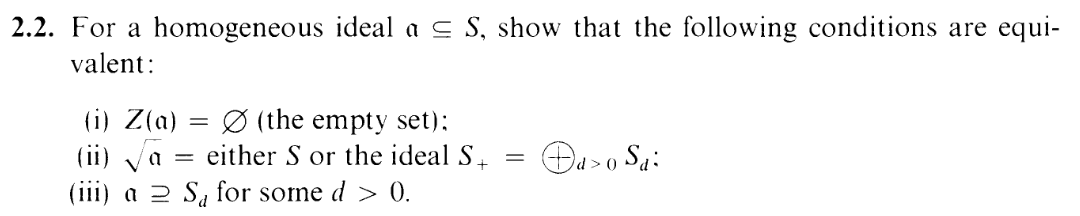
This post is mostly straight math. Feel free to skip this post if you only like squiggly math.
SOME NOTES TO MYSELF BEFORE BEGINNING:
I covered some of the cases of Z(α) = ∅ in the previous post. Note that, in (ii), the  = S
case
DOESN'T break the homogenous Nullstellensatz, whereas the
 = S
+ COULD break the homogenous
Nullstellensatz.
Also, in the previous post, I supposed that the degree of 0 in S = k[x0,x1,…,xn] ought to be 0. Oddly, it appears
that this isn't the case. It appears that 0 transcends degree. See condition (ii) in this exercise. The ideal  can be
equal to S+, which contains NO zero degree elements. And yet, since
 is an ideal, we must have 0 ∈
 i.e.
0 ∈ S+. So 0 is in the positive degree part of S. However. S0 itself is the same as k, and certainly 0 ∈ k. so
0 ∈ S0. So it's in the zero degree part of S as well. SO, basically, you can't put a degree on 0. I'll keep that in
mind, I guess.
OKAY NOTES FIN. LET'S BEGIN.
(i)  (ii):
Let f ∈ S be homogenous positive degree. Then vacuously ∀P ∈ Z(α) : f(P) = 0 (since (i) says Z(α) = ∅).
By the homgenous Nullstellensatz (2.1), fq ∈ α for some q > 0 i.e. f ∈ .
Thus, we've established that S+ ⊂ .
CASE 1: 1 ∈ α
Then α = S.
CASE 2: 1 α
Then certainly 1
 (else 1q = 1 ∈ α, a contradiction). But if 1

 then c

 for any nonzero constant
c ∈ k (otherwise we'd have c⋅
 = 1 ∈ α, a contradiction). I.e. ∀c ∈ S0 : c

 . So
 must be contained in
S+. I.e.
 ⊂ S
+.
DONE.
(ii)  (iii):
CASE 1:  = S
Then 1 ∈ , which means that 1q ∈ α for some q, but this just means that 1 ∈ alpha i.e. α = S. But
S ⊃ Sd. CASE 1 DONE.
CASE 2:  = S
+:
Suppose THIS were true:
 | (1) |
(we're working in Pn by the way lol)
(also, shouldn't have used k cause that usually refers to the field but fuck it too late lol)
Then for d = k(n + 1), consider Sd.
Let cx0k0x1k1 xnkn be an arbitrary term of Sd.
We have to have k0 + k1 +  + kn = d, which means that we have to have ki >=k for at least one i. Assume
without loss of generality that i = 0. Then we can rewrite that arbitrary term by factoring out an
x0k:
x0k(cx0k0-kx1k1 xnkn)
But this guy is actually in α, since x0k ∈ α (by (1)) and x0k ⋅ f ∈ α for any f ∈ S (since α is an ideal). So we
basically showed that an arbitrary element of S0 is in α. I.e. we showed S0 ⊂ α.
To finish off case 2, we just need to show that (1) is true. Since  = S
by assumption, we must have
x0,…,xn ∈
 . I.e. for each i = 0,…,n, we have ximi ∈ α for some mi > 0. But then certainly
xim0m1
 mi
 mn ∈ α. (e.g. (x0m0)m1
 mn ∈ α, etc.).
CASE 2 DONE.
(iii)  (i):
We're given α ⊃ Sd. Taking Z(⋅) of both sides, we reverse the inclusion, yielding
 | (2) |
But since x0d,x1d,…,xnd ∈ Sd, a point P would have to be all 0 in order to be 0 at all of these (since k is an
integral domain!) and this can't happen in Pn, so we actually have Z(Sd) = ∅. So by (2), Z(α) ⊂∅ i.e.
Z(α) = ∅.